Mitsubishi Triton 2010 review

|

Thursday, May 5, 2011


New car report; Triton toughens up

At first glance, the new Mitsubishi Triton appears largely unchanged, but dig deeper and you'll find that Mitsubishi have addressed any shortcomings and turned a good truck into a great one.
Major upgrades include a new high powered 2,477cc diesel engine for the 4WD models, enlarged carrying capacity, increased towing ability and improved safety features.  Other upgrades include some subtle styling and trim enhancements, modified bumpers, grille and lights, and the inclusion of cruise control as standard equipment.

The biggest criticism of the Triton has been its limited load carrying capacity, but Mitsubishi has well and truly sorted that out with the tray receiving a 180mm extension in length and a 55mm increase in depth, making for a 14% increase in capacity.

Sensational new diesel engine

The 4WD's new 2.5 litre Common Rail Intercooled Turbo-Diesel engine produces 133kW at 4,000rpm and 407Nm of torque at 2,000rpm, significant increases over the 120kW, 353Nm 3.2 litre powerplant it replaces.

Improvements to combustion chamber design, injector specification, increasing turbo boost and adding a variable geometry turbocharger are to thank for the added power from the smaller capacity engine.

Fuel consumption is also enhanced, with mixed cycle consumption quoted at 8.3L/100km for the manual and 9.3L/100km for the auto.


Two wheel drive models retain the existing 2.5 litre 102Kw diesel powerplant, but that too has come in for some engineering upgrades, improving fuel consumption to 8.2L/100km for the manual and 8.6L/100km for the auto.

No petrol versions are offered.

Of the safety improvements, 8 of the new 13 models now get side and curtain airbags. All models get a minimum of dual airbags, ABS brakes with electronic brakeforce distribution and all but the entry level models get ASC (active stability control) and ATC (active traction control).

The entry level workhorse GL models have a 5 speed manual transmission, while the Double Cab GLX is offered with the option of a 5 speed manual or 4 speed auto. 

GL and GLX models are equipped with Easy Select 4WD which allows the driver to move from 2H to 4H on the fly at speeds up to 100km/h. To select 4L the vehicle must be stationary and the gear-shifter in neutral.

Step up to the GLS and the automatic option gets 5 ratios with a Sports Mode Super Select. Like Easy Select, Super Select allows the driver to move from 2H to 4H on the fly. The benefit of Super Select is that drive to the front wheels will only be engaged when rear traction sensors detect slippage.
GL models are equipped with 16 inch steel wheels, audio system with CD player, halogen headlights, air-conditioning, electric door mirrors, electric front windows and on/off switch for the passenger airbag. GLX models get cruise control, with operating controls on the steering wheel. 

GLS models add 17 inch alloy wheels, audio controls on a leather bound steering wheel, electric rear windows, front fog lights, a sunglass pocket and a 6 speaker sound system with MP3 and auxiliary input jack.

Well priced and well worth a look


Mitsubishi may not be the first name that springs to mind when shopping for a ute, but with attractive styling, a wide range of models, and towing capacities of up to 3,000kg braked, depending on model, the Triton has evolved into a more than worthy tough truck that should be included on the shopping list. 

Scorecard (out of 5)
Styling:
4
Practicality:
4
Safety:
4
Value for money:
4
Innovation:
3
Total:
3.8


ASX: A spacious steed

|

Tuesday, May 3, 2011


There's little argument that looks create an impression, and at first glance, the Mitsubishi ASX suggests some mojo and even allure. It has the comportment of an SUV in that it gives you a higher perspective of the road than a sedan, and has the apparent bulk.

Yet, it isn’t exactly the sort of thing you would want to take into the wilds. This is chiefly an urban lifestyle vehicle, comfortably falling into the crossover category. During a weekend I had the ASX, it eceived a number compliments over its looks.   This certainly is a fine-looking set of wheels, with a yin yang mix of muscle and svelte lines. The impression extends into the cabin where, despite the black theme that is interrupted only by the silver highlights on the steering wheel, floor console and centre piece, the ASX continues to ooze a quiet and understated elegance.


Space-wise, it is generously endowed and will carry four or five adults comfortably; the 442 litres of cargo area is airy enough to accommodate all the weekend luggage of the occupants as well. The ride, once you get going, is tuned for comfort, and despite a bit of roll, the ASX tackles uneven surfaces with hardly a suggestion to its occupants of what it is tackling.

As an urban lifestyle vehicle and with the features onboard, the ASX is perfect for those seeking an alternative and stress-free ride.


Still, there’s a “however” . . .

Okay, I’ll get to the point - since we don’t have soccer mums here, the ASX makes a pitch for the run-around mum! She, who has to drop the kids off at school and pick them up, transport them to tuition classes and other activities, and is part of the neighbourhood car-pool. She will love how smooth and easy the ASX is to handle, allowing its occupants to enjoy a graceful and comfortable ride as it soaks up bumps and roughs without fuss.

The more hard-nosed driver, though, may take umbrage at the polite disposition of the engine, which is not an unsubstantial unit - a 2.0-litre, 16-valve and DOHC Mivec configuration, dishing out a respectable 150bhp and 197Nm.

While the six-speed CVT and a sports mode allow the driver some control over the powerplant’s response, a weekend with the ASX revealed its true nature, appealing more to the sedate driver than aggressive one. Attempts to provoke it to respond rudely were met, despite the surprising roar of a sporty exhaust, with dignified disdain. The 215/65/R16 size tyres seemed almost excessive, given this scenario.

You do get some features that will go down well with many, like the reverse camera routed to the large and bright colour display on the dashboard. This proved to be extremely useful when parking or backing out, even at night.  The ASX’s overall length is 4,295mm, a bit shorter than I expected after seeing it in photographs.

The 1,770mm width and hydraulic power steering assist make the ASX a breeze to slot into tight spaces, while the 1,615mm height doesn’t required a major adjustment of driving style for those more at home with sedans.

Other features on the ASX are magnesium gear shift paddles on the steering wheel, fully automated air-conditioning for the front and rear, cruise control, adjustable front centre armrest with lower and higher storage compartments, colour multi-information LCD display, dual front and driver’s knee airbags, hill-start assist, anti-lock braking system with electronic brakeforce distribution, active traction control and leather seats.

The Mitsubishi ASX, available in five colours (black, grey, blue, red and white), is priced at RM136,208 (without insurance), which is quite competitive in its category.  An optional accessories package is available for RM6,490. 

This includes front corner extension, front under cover, rear garnish, chrome-plated door mirror cover, side wind deflector, rear bumper plate, tail-gate protector, aluminum/black leather gear shift knob, scuff plates, side tray lids, luggage net in cargo hold and luggage mat.


Mitsubishi Pajero from ANCAP Crash Test

|

Sunday, May 1, 2011


Occupant Protection Score
28.41 out of 37
Pedestrian Protection Rating
2 out of 36
Poor
MakeMitsubishi
ModelPajero
CategoryLarge SUV
Body TypeSUV
VariantGL
Tested Vehicles Built2010
Airbags (if supplied)Dual front, side + head-protecting side curtains
Engine size3.8 diesel, manual L
Kerb Weight2270 kg
Test Date16 March 2011
Tested ByANCAP


Model History and Safety Features


The tested model of Mitsubishi Pajero was introduced in Australia during 2006. This 4 star ANCAP rating applies to all variants, with or without side airbags and curtains.

Dual front airbags, side airbags and head-protecting side curtains are now standard equipment. Antilock brakes (ABS), electronic brake distribution (EBD) and electronic stability control (ESC) are also standard. An advanced seat belt reminder is fitted to the driver seat. A reversing camera is available for some variants.


Pretensioners are fitted to the front seat belts to reduce slack in the event of a crash. A three point seat belt is fitted to the centre rear seat. This provides better protection than a two point (lap) seat belt. 


Occupant protection: 4 stars

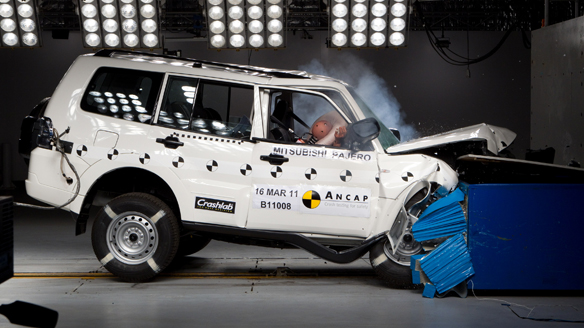
The Pajero scored 11.41 out of 16 in the offset crash test. The passenger compartment held its shape reasonably well. Protection from serious leg injury was marginal for the driver.

The vehicle was awarded a default score of 16 out of 16 in the side impact crash test. 

Frontal offset crash test


Mitsubishi Pajero injury outcomes
Body region scores out of 4 points each: Head/neck 4 pts, chest 3.90 pts, upper legs 2 pts, lower legs 1.51 pts.

The passenger compartment held its shape reasonably well in the offset crash test. There were signs of loss of integrity for the a-pillar and driver's door and rupture of the footwell. The clutch pedal moved rearwards by 130 mm and upwards 66 mm. The steering wheel hub moved 16 mm rearward, 68 mm upward and 13 mm sideways. The front ("A") pillar moved 41 mm rearwards. All doors remained closed during the crash. After the crash the driver’s door could be opened with high manual effort. The tailshaft moved sideways and contacted the fuel tank shield. The tank was undamaged.


The airbag cushioned the head of the driver and contact was stable. Steering column components were a potential source of injury for the driver's knees. The passenger's head was cushioned by the airbag.

Side impact crash test


Body region scores out of 4 points each: Head 4 pts, chest 4 pts, abdomen 4 pts, pelvis 4 pts.

The side impact test normally used by ANCAP simulates a small car striking the driver's door of the vehicle under test. It is based on a regulation test but the regulation does not apply to vehicles with a high seat height like the Pajero. Experience shows that such vehicles can be expected to perform well in this test so ANCAP has decided to award full score for these vehicles instead of conducting a crash test. No pole test was conducted. 


Pedestrian protection: poor


All areas except the middle of the bumper performed poorly. 


Modifiers - Offset test scores


HeadNo deduction
ChestNo deduction
Upper leg2 pt deduction Left & Right
Lower legNo deduction
Foot scorePedal displacement and footwell rupture -score 1.8 points
Note: Steering column and pedal movements are measured relative to the driver's seat.

Other Modifiers


Default score awarded

Safety Features


Driver airbagS
Antilock (ABS) brakes / Electronic brake distributionS/S/S
Passenger front airbagS
Electronic stability control (ESC, VSC, DSc, ESP, VSA)S#
Side airbags, front seats - chest protectionS
3 point centre rear seat beltS
Side airbags, front seats - head protectionS
Side airbags, rear seats - head protectionS
Intelligent seat belt reminder - driverS
Intelligent seat belt reminder - front passengerX
Whiplash protection (RCAR protocol)Pending
Driver knee airbagX
Front/rear seat belt pretensionersS
Rear seat belt status indicatorX
Key:
√ = Fitted to vehicle that was crash tested (where not standard)
S = standard on all models
S* = Standard for petrol models but not available for LPG models until 1 May 2009
O = optional on base variant. May be standard on higher variants
V = not available on base variant but standard or optional on higher variants
X = not available on any variant.
* = not available on the Australian model
# ESC required by ANCAP for 5 star rating from 2008. 
  

Injury Measurements


Refer to the information sheet "How the tests are done"

Offset Crash Test
at 64 km/h
(v4.1)

Side Impact
Crash at
50 km/h
(v4.1)


Driver

Passenger

Driver

Head

HIC231302Default score awarded
Acceleration (g for 3ms)41.241.9Default score awarded 
Head Injury Criterion (HIC) is a measure of the potential for head injury. At a HIC of 1000 one in 6 adults will suffer from life-threatening injury to their brain.


Neck

Shear (kN)0.600.58Default score awarded
Tension (kN)0.841.29Default score awarded
Extension (Nm)11.724.9Default score awarded

Chest

Acceleration (g for 3ms)48.30033.600Default score awarded
Compression (mm)22.7319.90Default score awarded
Viscous Criterion (m/s)0.070.05Default score awarded
Chest compression of 75 or more, or chest acceleration of 90 or more indicates poor protection from serious chest injury.


Abdomen

Force (kN)  Default score awarded

Pelvis

Force (kN)  Default score awarded


Upper Legs


Force Left (kN)0.130.38 
Force Right (kN)0.251.37 
Knee Disp. Left (mm)0.140.10 
Knee Disp. Right (mm)0.054.65 
An upper leg axial force of 10.9 or more indicates poor protection from serious upper leg (femur) injury.


Lower Legs


Force Left (kN)1.421.55 
Force Right (kN)2.161.66 
Index (upper/lower) Left0.27/0.960.8/0.15 
Index (upper/lower) Right0.44/0.230.35/0.38 
A lower leg index of 1.2 or more indicates poor protection from serious lower leg (tibia) injury.


Bonus points (maximum 5):

Pole test:Not testedSeat belt reminders:1 pont

Pedestrian rating


Child head impactsZeroUpper leg impactsZero
Adult head impactsZeroLower leg impacts2
Total2 out of 36 Poor