ASX: A spacious steed

|

Tuesday, May 3, 2011


There's little argument that looks create an impression, and at first glance, the Mitsubishi ASX suggests some mojo and even allure. It has the comportment of an SUV in that it gives you a higher perspective of the road than a sedan, and has the apparent bulk.

Yet, it isn’t exactly the sort of thing you would want to take into the wilds. This is chiefly an urban lifestyle vehicle, comfortably falling into the crossover category. During a weekend I had the ASX, it eceived a number compliments over its looks.   This certainly is a fine-looking set of wheels, with a yin yang mix of muscle and svelte lines. The impression extends into the cabin where, despite the black theme that is interrupted only by the silver highlights on the steering wheel, floor console and centre piece, the ASX continues to ooze a quiet and understated elegance.


Space-wise, it is generously endowed and will carry four or five adults comfortably; the 442 litres of cargo area is airy enough to accommodate all the weekend luggage of the occupants as well. The ride, once you get going, is tuned for comfort, and despite a bit of roll, the ASX tackles uneven surfaces with hardly a suggestion to its occupants of what it is tackling.

As an urban lifestyle vehicle and with the features onboard, the ASX is perfect for those seeking an alternative and stress-free ride.


Still, there’s a “however” . . .

Okay, I’ll get to the point - since we don’t have soccer mums here, the ASX makes a pitch for the run-around mum! She, who has to drop the kids off at school and pick them up, transport them to tuition classes and other activities, and is part of the neighbourhood car-pool. She will love how smooth and easy the ASX is to handle, allowing its occupants to enjoy a graceful and comfortable ride as it soaks up bumps and roughs without fuss.

The more hard-nosed driver, though, may take umbrage at the polite disposition of the engine, which is not an unsubstantial unit - a 2.0-litre, 16-valve and DOHC Mivec configuration, dishing out a respectable 150bhp and 197Nm.

While the six-speed CVT and a sports mode allow the driver some control over the powerplant’s response, a weekend with the ASX revealed its true nature, appealing more to the sedate driver than aggressive one. Attempts to provoke it to respond rudely were met, despite the surprising roar of a sporty exhaust, with dignified disdain. The 215/65/R16 size tyres seemed almost excessive, given this scenario.

You do get some features that will go down well with many, like the reverse camera routed to the large and bright colour display on the dashboard. This proved to be extremely useful when parking or backing out, even at night.  The ASX’s overall length is 4,295mm, a bit shorter than I expected after seeing it in photographs.

The 1,770mm width and hydraulic power steering assist make the ASX a breeze to slot into tight spaces, while the 1,615mm height doesn’t required a major adjustment of driving style for those more at home with sedans.

Other features on the ASX are magnesium gear shift paddles on the steering wheel, fully automated air-conditioning for the front and rear, cruise control, adjustable front centre armrest with lower and higher storage compartments, colour multi-information LCD display, dual front and driver’s knee airbags, hill-start assist, anti-lock braking system with electronic brakeforce distribution, active traction control and leather seats.

The Mitsubishi ASX, available in five colours (black, grey, blue, red and white), is priced at RM136,208 (without insurance), which is quite competitive in its category.  An optional accessories package is available for RM6,490. 

This includes front corner extension, front under cover, rear garnish, chrome-plated door mirror cover, side wind deflector, rear bumper plate, tail-gate protector, aluminum/black leather gear shift knob, scuff plates, side tray lids, luggage net in cargo hold and luggage mat.

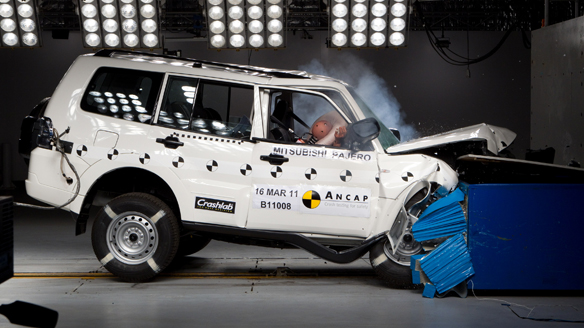
Mitsubishi Pajero from ANCAP Crash Test

|

Sunday, May 1, 2011


Occupant Protection Score
28.41 out of 37
Pedestrian Protection Rating
2 out of 36
Poor
MakeMitsubishi
ModelPajero
CategoryLarge SUV
Body TypeSUV
VariantGL
Tested Vehicles Built2010
Airbags (if supplied)Dual front, side + head-protecting side curtains
Engine size3.8 diesel, manual L
Kerb Weight2270 kg
Test Date16 March 2011
Tested ByANCAP


Model History and Safety Features


The tested model of Mitsubishi Pajero was introduced in Australia during 2006. This 4 star ANCAP rating applies to all variants, with or without side airbags and curtains.

Dual front airbags, side airbags and head-protecting side curtains are now standard equipment. Antilock brakes (ABS), electronic brake distribution (EBD) and electronic stability control (ESC) are also standard. An advanced seat belt reminder is fitted to the driver seat. A reversing camera is available for some variants.


Pretensioners are fitted to the front seat belts to reduce slack in the event of a crash. A three point seat belt is fitted to the centre rear seat. This provides better protection than a two point (lap) seat belt. 


Occupant protection: 4 stars

The Pajero scored 11.41 out of 16 in the offset crash test. The passenger compartment held its shape reasonably well. Protection from serious leg injury was marginal for the driver.

The vehicle was awarded a default score of 16 out of 16 in the side impact crash test. 

Frontal offset crash test


Mitsubishi Pajero injury outcomes
Body region scores out of 4 points each: Head/neck 4 pts, chest 3.90 pts, upper legs 2 pts, lower legs 1.51 pts.

The passenger compartment held its shape reasonably well in the offset crash test. There were signs of loss of integrity for the a-pillar and driver's door and rupture of the footwell. The clutch pedal moved rearwards by 130 mm and upwards 66 mm. The steering wheel hub moved 16 mm rearward, 68 mm upward and 13 mm sideways. The front ("A") pillar moved 41 mm rearwards. All doors remained closed during the crash. After the crash the driver’s door could be opened with high manual effort. The tailshaft moved sideways and contacted the fuel tank shield. The tank was undamaged.


The airbag cushioned the head of the driver and contact was stable. Steering column components were a potential source of injury for the driver's knees. The passenger's head was cushioned by the airbag.

Side impact crash test


Body region scores out of 4 points each: Head 4 pts, chest 4 pts, abdomen 4 pts, pelvis 4 pts.

The side impact test normally used by ANCAP simulates a small car striking the driver's door of the vehicle under test. It is based on a regulation test but the regulation does not apply to vehicles with a high seat height like the Pajero. Experience shows that such vehicles can be expected to perform well in this test so ANCAP has decided to award full score for these vehicles instead of conducting a crash test. No pole test was conducted. 


Pedestrian protection: poor


All areas except the middle of the bumper performed poorly. 


Modifiers - Offset test scores


HeadNo deduction
ChestNo deduction
Upper leg2 pt deduction Left & Right
Lower legNo deduction
Foot scorePedal displacement and footwell rupture -score 1.8 points
Note: Steering column and pedal movements are measured relative to the driver's seat.

Other Modifiers


Default score awarded

Safety Features


Driver airbagS
Antilock (ABS) brakes / Electronic brake distributionS/S/S
Passenger front airbagS
Electronic stability control (ESC, VSC, DSc, ESP, VSA)S#
Side airbags, front seats - chest protectionS
3 point centre rear seat beltS
Side airbags, front seats - head protectionS
Side airbags, rear seats - head protectionS
Intelligent seat belt reminder - driverS
Intelligent seat belt reminder - front passengerX
Whiplash protection (RCAR protocol)Pending
Driver knee airbagX
Front/rear seat belt pretensionersS
Rear seat belt status indicatorX
Key:
√ = Fitted to vehicle that was crash tested (where not standard)
S = standard on all models
S* = Standard for petrol models but not available for LPG models until 1 May 2009
O = optional on base variant. May be standard on higher variants
V = not available on base variant but standard or optional on higher variants
X = not available on any variant.
* = not available on the Australian model
# ESC required by ANCAP for 5 star rating from 2008. 
  

Injury Measurements


Refer to the information sheet "How the tests are done"

Offset Crash Test
at 64 km/h
(v4.1)

Side Impact
Crash at
50 km/h
(v4.1)


Driver

Passenger

Driver

Head

HIC231302Default score awarded
Acceleration (g for 3ms)41.241.9Default score awarded 
Head Injury Criterion (HIC) is a measure of the potential for head injury. At a HIC of 1000 one in 6 adults will suffer from life-threatening injury to their brain.


Neck

Shear (kN)0.600.58Default score awarded
Tension (kN)0.841.29Default score awarded
Extension (Nm)11.724.9Default score awarded

Chest

Acceleration (g for 3ms)48.30033.600Default score awarded
Compression (mm)22.7319.90Default score awarded
Viscous Criterion (m/s)0.070.05Default score awarded
Chest compression of 75 or more, or chest acceleration of 90 or more indicates poor protection from serious chest injury.


Abdomen

Force (kN)  Default score awarded

Pelvis

Force (kN)  Default score awarded


Upper Legs


Force Left (kN)0.130.38 
Force Right (kN)0.251.37 
Knee Disp. Left (mm)0.140.10 
Knee Disp. Right (mm)0.054.65 
An upper leg axial force of 10.9 or more indicates poor protection from serious upper leg (femur) injury.


Lower Legs


Force Left (kN)1.421.55 
Force Right (kN)2.161.66 
Index (upper/lower) Left0.27/0.960.8/0.15 
Index (upper/lower) Right0.44/0.230.35/0.38 
A lower leg index of 1.2 or more indicates poor protection from serious lower leg (tibia) injury.


Bonus points (maximum 5):

Pole test:Not testedSeat belt reminders:1 pont

Pedestrian rating


Child head impactsZeroUpper leg impactsZero
Adult head impactsZeroLower leg impacts2
Total2 out of 36 Poor   


2011 Audi TT-RS Roadster

|

Tuesday, March 22, 2011


audi tt-rs roadster by o ct

The Audi TT-RS will soon be headed to US shores and what’s better is that tuners are coming up with all kinds of packages for the luxury sports car that we will soon be able to take advantage of as well. The latest package comes from O.CT Company and takes the German sports car to a higher power with some handling improvements and an aesthetic upgrade.
While in its standard version, the Audi TT-RS develops a total of 340 HP and 450 NM of torque out of its turbocharged 2.5-liter engine, but O.CT has taken that power to a total of 420 HP and 570 Nm. In order to get this 80hp bump, the tuner opted for changing the hardware components in conjunction with the reprogramming of the vehicle’s electronics. The conversion kit used includes a stainless steel exhaust system including silencer and rear silencer with control valve, a charge air cooler kit, and a revised management of the TFSI engine.
For the exterior, the package adds forged 20-inch 5 twin-spoke alloy rims that only weigh 13.8 kg. There is also a new KW coilover suspension V3 that provides "agility in (almost!) any situation."
The makeover by O.CT Company is good, but we prefer the 472 HP engine update provided by MTM in their Audi TTRS Clubsport solely for the higher power output. If it was based on looks, then the O.CT package would win hands down.

Article sources: http://www.topspeed.com/

Lamborghini Aventador Roadster rendered

|

Friday, March 18, 2011

The Lamborghini Aventador just made its debut a couple of days ago and already artists are at work rendering a different version of the sports coupe. What we’re looking at is an Aventador roadster version, and we like what we see. Don’t get too excited though; an actual production roadster version isn’t expected until 2014.
 
The Aventador Roadster will look similar to the coupe version, except that the engine cover and roofline will be adapted to fit the roadster style. This rendering shows it in a silky, pearly bright-white finish with a two-tone black/white leather interior, making it look absolutely stunning.

The Aventador is powered by a new 6.5-liter V12 engine with an AWD layout that produces 700 horsepower and 479 lb/ft of torque. This engine hits 0-60 mph in just 2.5 seconds while blasting off a top speed of 217 mph and a redline of 8,250 RPM. With a total weight of 1575 Kg, it will deliver a power to weight ratio of 2.25 Kg/hp.

Articles sources:  topspeed

see more
pictures:


Ford's voice-controlled car goes on show

|

Monday, March 7, 2011


Next year Ford will introduce an in-car computer system that will allow drivers to use voice commands to make calls, navigate and choose music.
The Ford Sync system, which is built on Microsoft's Windows Embedded Automotive platform, will be available in Ford cars sold in Europe from 2012, starting with the Ford Focus, as seen here.
The computer system can be controlled using one of 10,000 voice commands in 19 different languages, through the touchscreen console on the car dashboard or buttons on the steering wheel.

The steering wheel has a five-button panel on each side that can be used to browse through the Ford Sync menus without the need for drivers to take their hands off the wheel.
 

A shot of the Ford Sync's in-car phone system, which will allow drivers to use voice commands to access their contacts and make or answer calls.
When the driver is on a call, Sync automatically reduces the volume of in-car music, then returns it to its previous volume once the call has finished.
Sync will also read out text messages and enables the driver to reply to text messages by choosing from a list of potted phrases such as, "I'm on my way".
The system will also automatically call the local emergency services number and announce there has been a crash, communicating the car's location, in the event of an accident where the car's airbag is deployed.
Drivers will be able to connect their smartphones wirelessly to the Ford Sync system via USB or Bluetooth.

Sync's navigation system provides turn-by-turn directions to a destination, both reading them out and displaying them on a map on the touchscreen.
Destinations can be set via voice commands or by using the touchscreen.
Voice commands can also be used to find the nearest relevant business or place of interest. For example, saying "I'm hungry" will prompt the car to read out and display information on nearby restaurants, using information from The Michelin Guide. Once the driver selects a restaurant, the Sync will provide contact details for the outlet and directions.
Sync's other navigation abilities include being able to select the shortest or fastest route to a destination, or the route that it estimates will use the least fuel.


Sync can access music stored on MP3 players, smartphones, USB sticks and memory cards, alongside the car's built-in radio.
Drivers will be able to select the music or radio station they want to listen to via voice commands or buttons on the steering wheel, with Sync capable of recognising spoken album, band and track names.

Voice commands or touchscreen controls can also be used to set the temperature inside the car and adjust various fans and heaters, as well as the air con.


The Ford Sync can also function as a wi-fi hotspot, allowing passengers in the car to use the internet.
The system creates a wi-fi hotspot using a USB modem plugged into Sync, or through the phone connection of a mobile linked to Sync via Bluetooth.

Drivers will be able to customise the Ford Sync system by setting the homescreen wallpaper, for example, as seen here.
When it launches in Europe, Ford Sync is also expected to include AppLink, a feature that will allow smartphone apps to be developed that can be controlled via Sync.
Specially developed apps for Apple iOS, BlackBerry and Google Android handsets are expected to be supported

Sync can also provide a selection of general information such as nearby traffic, weather and local film showing times.

article and pictures sources: Nick Heath/silicon.com


Hyundai brings to life ‘New Thinking. New Possibilities.’ at 2011 Geneva Motor Show

|

Hyundai today unveils three new models to a European audience at the 2011 Salon International de L’Automobile in Geneva.  All three cars encapsulate the spirit of Hyundai’s new brand slogan, ‘New Thinking. New Possibilities.’ ? which itself is launched in Europe today.

Making its world premiere at the show, Hyundai’s all-new, Europe-specific D-segment model, the i40, takes centre stage.  The i40 was designed and engineered at Hyundai’s R&D headquarters in Russelsheim,Germany, to meet the exacting demands of European retail and fleet buyers.  It is being unveiled in wagon form at the Show.

With the i40, Hyundai sets out to make premium quality accessible to everyone, in line with its ‘modern premium’ philosophy.  A number of features on i40 are not yet available on competitor cars, including heated, folding rear seats; an auto-defog system that automatically detects and clears mist on the windscreen; and a heated steering wheel.


Furthermore, the i40 demonstrates Hyundai’s commitment to global leadership in eco-friendly technology, with its 1,7-liter ‘U-II’ diesel engine emitting as little as 113 g/km of CO2 ? a best-in-class figure.  In addition, the ‘Nu’ 2,0-liter petrol engine makes its debut, delivering higher torque for enhanced driveability, improving fuel economy, reducing emissions, and providing greater refinement and durability compared to the outgoing 2,0-liter unit.

The industry-leading Five Year Triple Care assurance package comes as standard on i40, featuring a five-year unlimited-mileage warranty, five years’ roadside assistance and five years of vehicle health checks.

The i40 is joined on the Hyundai booth by the new Veloster, the company’s groundbreaking all-new three-door coupe that makes its European debut.  The Veloster features a unique 1+2 door configuration, which includes a rear door on the passenger side for greater useability, giving safe and easy access to the spacious interior without compromising the style and aesthetics of the coupe form.

The Veloster redefines the sports coupe segment, with its unparalleled combination of real-world practicality, sporting looks and cutting-edge technology.  With Hyundai’s new six-speed double-clutch transmission and an efficient 1.6-liter GDI engine, the Veloster has lowest-in-class CO2 emissions of just 132 g/km, completing the car’s innovative package.

Another model making its European premiere is the Curb concept.  Codenamed HCD-12, the compact Urban Activity Vehicle (UAV) features next-generation styling influenced by Hyundai’s ‘fluidic sculpture’ form language.  The Curb serves as a test bed for future Hyundai Blue Link™ telematics technology, offering a broad range of connectivity options, and runs a 1.6-liter, 175 ps petrol engine.


Hyundai will also showcase the latest products to be developed under its Blue DriveTM sub-brand, further demonstrating the company’s efforts to minimise its global corporate environmental impact.  The ix35 FCEV is Hyundai’s third-generation fuel cell electric vehicle that includes a 55% improvement in driving range, a 15% increase in fuel efficiency and an 80% reduction in manufacturing costs compared to the previous generation.  These enhancements help the SUV to cover 650 kilometers on a single charge

Another Blue Drive innovation on the Hyundai booth is Sonata HEV, the company’s first full hybrid, that was developed entirely in-house by Hyundai and includes several technical firsts.

The Hyundai BlueOn, powered by an innovative 16.4 kWh LiPoly (lithium-ion polymer) battery, is also on display.  Advantages of Li-Poly battery power include 30% less weight, 40% less volume, and 15% increase in efficiency compared to other competing technologies.   Its maximum power of 81 ps (61kW) and maximum torque of 21.4 kg/m (210Nm) carry the BlueOn to a top speed of 130 kph.